

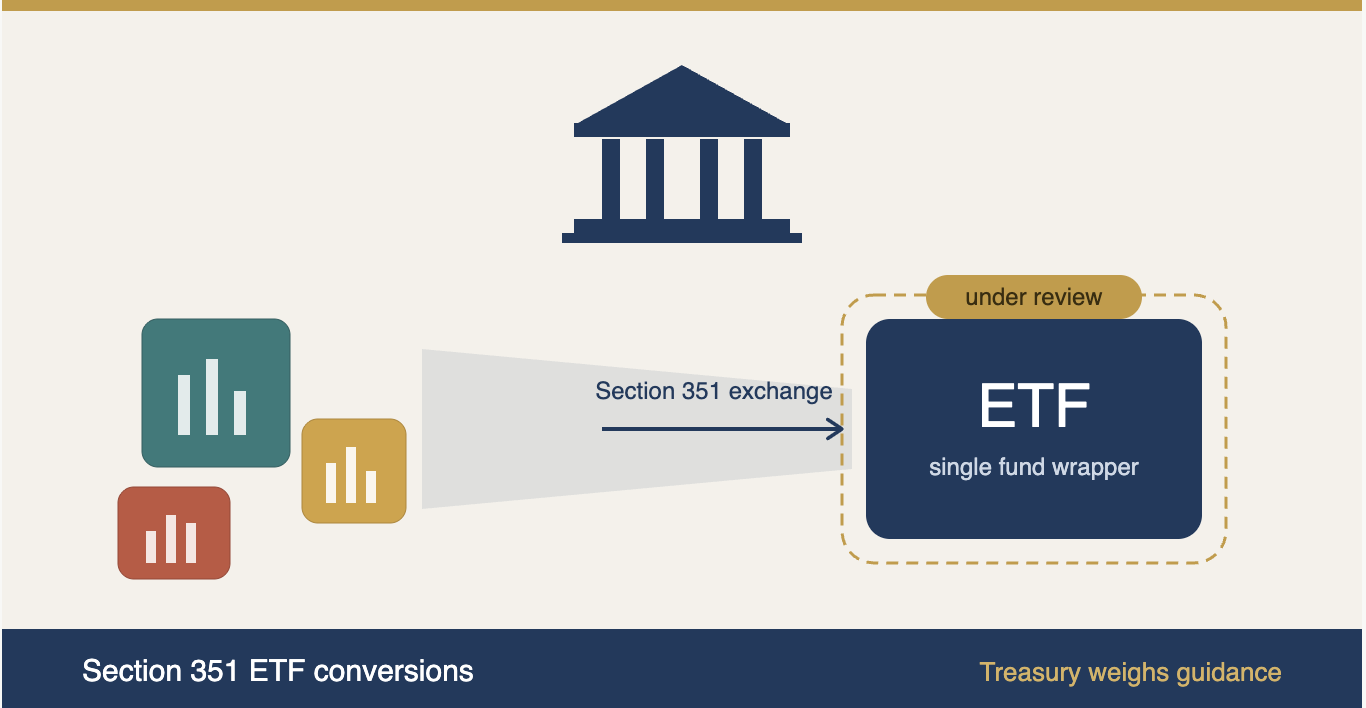
The Investment Company Institute has filed a comment letter with the Treasury Department asking for guidance on 351 conversions. The strategy lets investors move concentrated stock positions or full portfolios into ETFs without triggering an immediate capital gains bill, as Bloomberg reports.
Why it matters
ICI has met with Treasury officials twice. At one point those officials discussed restricting the practice or labeling certain deals a “transaction of interest,” a tag that can bring added reporting requirements.
What ICI is saying
ICI Deputy General Counsel Mike Horn told the ICI ETF Conference that members want certainty. Many are looking at the strategy and asking Treasury to just state the rules.
The detail
Use of 351 conversions is expanding, and firms want clarity as it grows. The strategy can help investors diversify a concentrated position or rebalance a portfolio without an immediate tax bill. Some deals have drawn scrutiny when an ETF’s holdings change quickly and substantially after launch. Investors also move into ETFs for reasons beyond tax, including lower fees, more liquidity, and a preference for holding assets in brokerage accounts.
Where ICI and Treasury agree
Both sides agree investors should not contribute securities to an ETF without intent to hold them after conversion. Horn’s point was that regulators should target abusive deals, not the practice itself. Some transactions are problematic, but the strategy has legitimate non-tax uses, so the answer is to address the bad cases rather than shut the door on the whole industry. He believes that message landed.
Looking ahead
Treasury is still evaluating 351 conversions. No action may be forthcoming.
Sources: Bloomberg and the Investment Company Institute.