

ExchangiFi’s new white paper sizes the Section 351 conversion opportunity at an estimated $5.0 trillion. The number gets the attention. The compliance architecture decides who can actually use it. Section 351’s nonrecognition treatment is conditional, and the conditions are unforgiving.
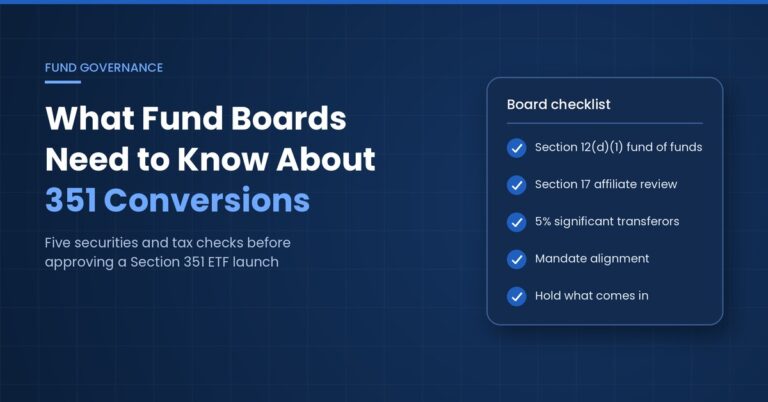
The central obstacle is Section 351(e). To stop investors from pooling concentrated stock into instant tax-free diversification, the provision withholds nonrecognition if the receiving entity counts as an investment company. Clearing it requires a diversification test drawn from the RIC rules under Section 368(a)(2)(F). In practice, a contributed basket must satisfy three structural limits at once, plus a control test.
- The 25% single-issuer cap. No one security can exceed 25% of the basket’s value.
- The 50% concentration limit. Holdings that each exceed 5%, or the five largest combined, cannot together exceed 50% of the basket.
- The 11-issuer floor. Meeting both limits simultaneously requires at least 11 separate holdings. A single-stock holder cannot qualify alone and must contribute into an already diversified pool or alongside complementary contributors.
- The 80% control requirement. Contributing investors must together own at least 80% of the entity’s voting power and shares immediately after the exchange.
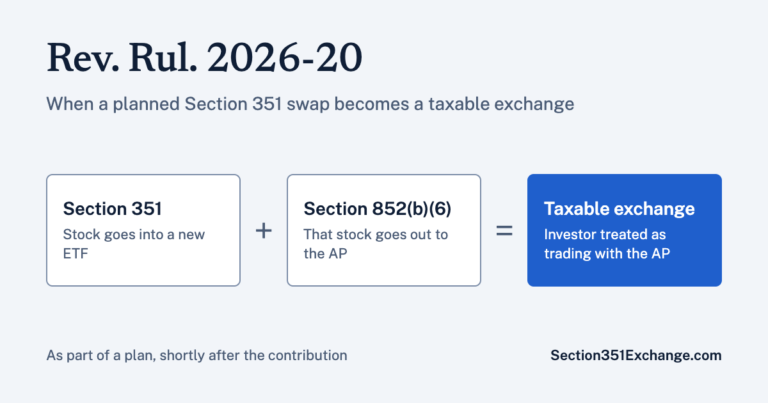
Passing the quantitative tests at the moment of contribution is necessary but not sufficient. Anti-abuse doctrine looks at intent and conduct. There can be no pre-arranged plan to dispose of contributed assets outside the ordinary course. Regulators and industry commentary warn against “stuffing,” contributing appreciated assets that do not fit the entity’s stated strategy. And “sequential seeding,” repeatedly spinning up funds mainly to park appreciated single stocks, has become a focus for tax authorities.
The practical implication is that structural compliance is the price of admission to this market. Diversification must be tested lot by lot at contribution. Basis tracking must survive the transfer. Documentation must show why each deal makes sense against the fund’s strategy. These tests are fact-specific, and how they apply to any one portfolio should always be confirmed with qualified tax counsel.
ExchangiFi’s platform automates the quantitative testing and produces the documentation trail the structure demands.
Review our regulatory framework and run the compliance calculator on your basket.