Treasury and the IRS have put certain tax-aware financial product strategies on notice. A recent Perkins Coie panel moderated by Mohsen Ghazi, with partners Sharon Kim and Vivek Chandrasekhar, walked through what that scrutiny actually covers. The short version is that ordinary ETF activity and ordinary tax loss harvesting are not the target. Stacked structures are.
The concern is stacking, not the ETF wrapper
The issue Treasury raised at the Wall Street Tax Association panel this summer is the combination of separate code provisions inside a single product structure. Tiered ETFs that redeem out of a lower-tier fund before a dividend is paid. Box spread ETFs that deliver a fixed, interest-like return as NAV appreciation. Trader funds that hold a swap loss leg through its scheduled payment for ordinary loss while terminating the gain leg early for capital treatment under Section 1234A.
Marketing matters on its own. Guaranteed or near-guaranteed tax outcomes advertised by an advisor or administrator draw attention independent of the structure, and they can undercut the commercial purpose argument later.
Section 852(b)(6) sits underneath all of it
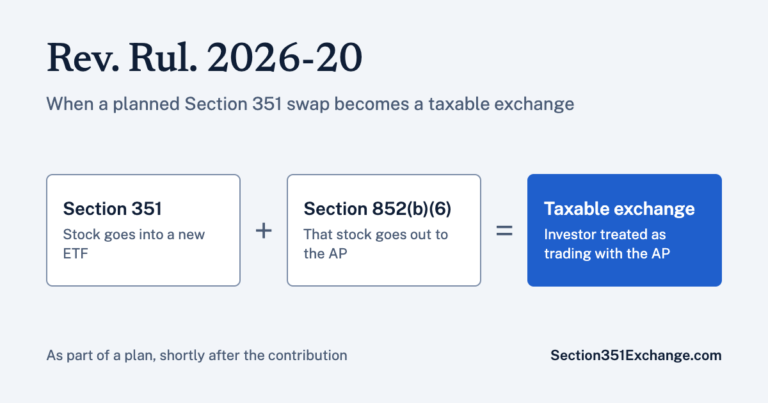
Section 852(b)(6) lets a regulated investment company distribute appreciated property in a qualifying redemption without recognizing gain at the fund level. It survived the 1986 repeal of General Utilities. Repeal proposals exist, but there is no current appetite for one. Congress is not going to hit investors twice in a correction, once on the portfolio and again with a tax bill on securities the investor never sold.
SIH Partners shows the limits of existing law
In SIH Partners LLLP v. Commissioner, decided August 6, 2026, the taxpayer cleared the mechanical substantial overlap test and still lost. The court applied a written anti-abuse rule sitting inside the same regulation. No comparable rule exists under Section 351 or Section 852(b)(6) today. Treasury would have to write one.
What advisors should do now
Understand the arguments the government would make against a structure before using it. Document the commercial rationale contemporaneously, because after the fact does not hold up. A straightforward Section 351 exchange seeks tax-deferred treatment under rules that are clear and long-standing. The scrutiny is aimed at what gets stacked on top.
This is informational commentary and not tax or legal advice.