
What Fund Boards Need to Know About 351 Conversions
Section 351 ETF conversions have moved from niche to mainstream. More advisers now seed new ETFs with appreciated client portfolios on a tax-deferred basis. Every one of those 351 conversions lands in front of a fund board.
The tax side gets most of the attention. The securities side is where boards can get caught.
The Mutual Fund Directors Forum recently hosted a webinar on this topic with Karen Aspinall and Ray Holst of Practus LLP. It was one of the most practical sessions I have seen for trustees. Together with a recent SEC enforcement action, it points to five checks every fund board should run before it approves a 351 conversion.
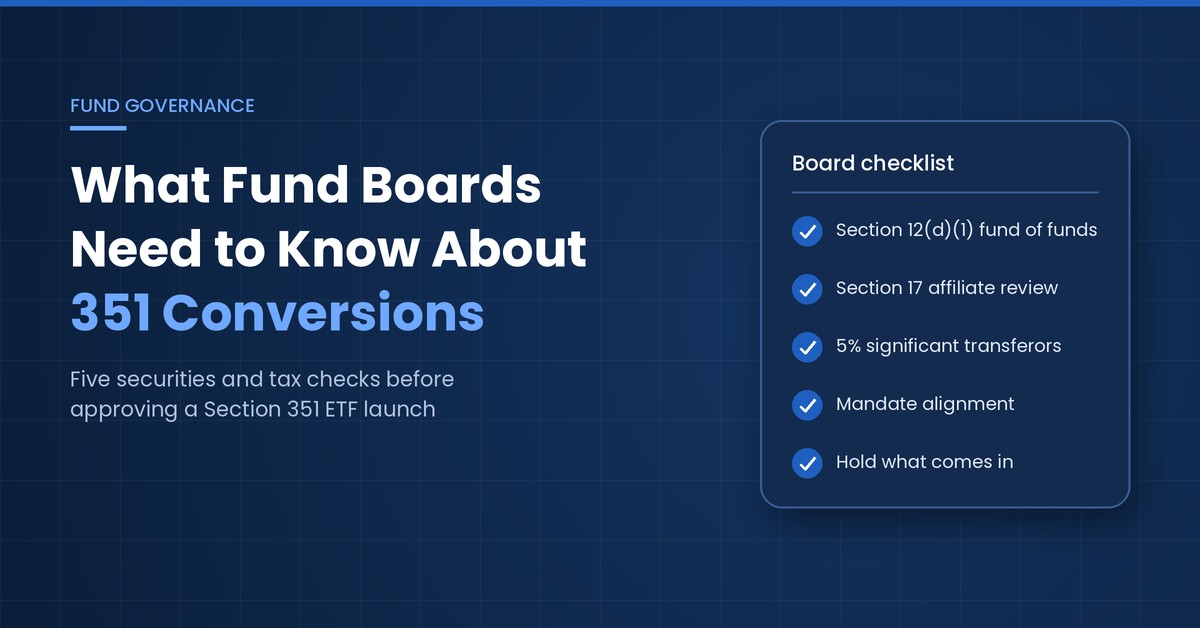
Key takeaways for fund boards
- Run a Section 12(d)(1) fund of funds check if any contributor is a registered fund or a private fund.
- Screen every contributor for Section 17 affiliations with the adviser, sub-adviser, and distributor.
- Identify significant transferors who will own 5% or more of the ETF after the exchange.
- Confirm the contributed securities fit the fund’s mandate.
- Plan to hold contributed securities unless there is a real investment reason to sell.
1. Run the Section 12(d)(1) fund of funds check
Most 351 contributors are individuals, families, and trusts moving separately managed account portfolios. They are not investment companies. So Section 12(d)(1) of the Investment Company Act rarely comes up. That is exactly why it can get missed.
Section 12(d)(1) limits how much of one fund another fund can own. The general limit is 3% of the acquired fund’s outstanding voting stock. It works in both directions. Another fund generally cannot buy more than 3% of your ETF. Your ETF generally cannot sell more than 3% of its shares to another investment company.
In a 351 conversion, early contributors often own a large share of the fund on day one. The 3% limit can apply if a contributor is a registered fund. It can also apply if a contributor is a private fund that relies on Section 3(c)(1) or 3(c)(7). Some family investment vehicles and pooled structures fall into that group.
The exemptions are narrow. Rule 12d1-4 lets registered funds and business development companies go above 3%. It comes with conditions, including limits on control of the acquired fund. Private funds cannot rely on Rule 12d1-4 at all.
The question for the board is simple. What type of entity is each contributor? If one of them is a fund, what exemption applies?
2. Screen every contributor for Section 17 affiliations
Section 17(a) prohibits an affiliated person of a fund from selling securities to the fund. The same rule applies to an affiliate of that affiliate. A 351 contribution is a transfer of securities to the fund in exchange for fund shares. If the contributor is an affiliate, the contribution can be a prohibited transaction unless the SEC grants exemptive relief.
The definition reaches further than many people expect. The adviser is an affiliate of the fund. Anyone who owns 5% or more of the adviser’s voting securities is an affiliate of the adviser. So are the adviser’s officers, directors, and employees. That makes an owner of the adviser, or a principal contributing a personal portfolio, a second-tier affiliate of the fund.
The Simplify SURI case
This is not theoretical. On July 27, 2026, the SEC issued a settled order against Simplify Asset Management. Part of the order involved the launch of the Simplify Propel Opportunities ETF (SURI).
According to the order, a trust held an approximately 25% fully diluted equity interest in Simplify through preferred shares. Those shares gave the trust the right to select two of the four directors on Simplify’s board. The trust seeded SURI with about $71.5 million of securities in February 2023. It contributed another $35.7 million in June 2023.
Simplify told the fund’s board the trust was not an affiliate. It did not share the basis for that conclusion. A trustee of the contributing trust was also a portfolio manager of the fund. No application for exemptive relief was filed.
The SEC found the trust was a second-tier affiliate of SURI. It found Simplify caused a Section 17(a)(1) violation. The $400,000 penalty also covered other violations in the order. Simplify settled without admitting or denying the findings.
The order carried one more lesson for boards. The basket for the June 2023 contribution included securities the fund did not already hold. The fund recorded it as a “rebalance” basket. Records should describe what actually happened.
What boards should ask for
Boards should expect an ownership review that reaches the adviser, any sub-adviser, and the distributor. Voting rights count, including board appointment rights. When the adviser concludes a contributor is not an affiliate, the board should see the reasoning. A bare conclusion is not enough.
3. Identify significant transferors (the 5% rule)
The IRS reporting rules for 351 conversions are simpler than most people assume.
Treasury Regulation §1.351-3 defines a “significant transferor.” For a publicly traded ETF, it is a contributor who owns 5% or more of the outstanding shares immediately after the exchange. That contributor attaches a short statement to their federal income tax return for the year of the exchange. For an individual, that return is Form 1040.
The statement is basic. It lists the ETF’s name, its employer identification number, and the date of the transfer. It also lists the aggregate fair market value and cost basis of the property contributed.
A contributor below 5% has no special filing. Their cost basis and holding period carry over to the ETF shares on the custodian’s records. Nothing is reported until they sell. At that point the broker issues a Form 1099-B.
There is a board angle here too. The ETF must file its own statement for property it receives from significant transferors. New launches concentrate ownership in a small group of early contributors, so this comes up more often than people expect. The fund’s tax reporting process should identify significant transferors from day one.
4. Confirm contributed securities fit the fund’s mandate
Managers take different views on how closely contributed securities need to match the fund’s target portfolio. In practice, the range I hear is generally 80% to 100% alignment.
The less obvious point is more basic. The securities going into the fund should be part of the fund’s mandate. A large-cap U.S. equity ETF should not take in Brazilian bonds, even if every contributor passes the tax tests. A mismatch invites questions from the SEC about whether the fund follows its stated strategy. It also invites questions from the IRS about whether the transaction had a real investment purpose.
A registered fund has to hold investments consistent with its objective and policies. If the fund’s name suggests a focus, the Names Rule generally requires an 80% investment policy tied to that focus. The board should see the adviser’s written process for evaluating contributed securities. It should also see the alignment analysis for the actual portfolio.
5. Plan to hold contributed securities
No specific rules govern a Section 351 contribution followed by in-kind redemptions under Section 852(b)(6). Section 852(b)(6) lets an ETF deliver appreciated securities out in kind without recognizing gain at the fund level. Treasury has indicated it is reviewing how the two provisions interact. Guidance may or may not come.
Until it does, the practical approach is straightforward. Treat contributed securities as long-term holdings. Do not accept anything with a pre-planned exit. Sell or deliver out contributed securities only when there is a real investment reason to do so.
After launch, the adviser is a fiduciary to the fund and all of its shareholders. The strategy and market conditions should drive portfolio decisions, not the seeding transaction. The board should expect the adviser to document the business purpose for any sale of contributed securities. That documentation matters most in the first year.
Are 351 conversions a tax loophole?
IRS and Treasury officials spoke at a Wall Street Tax Association meeting in July. Afterward, several articles framed 351 ETFs as a tax loophole about to close. I think that coverage was overblown.
According to a K&L Gates summary of the meeting, officials declined to bless any particular transaction. They also acknowledged that 351 contributions are viable when two things are true. The assets fit the ETF’s investment profile. Dispositions happen in the ordinary course of business. That is the same discipline described above.
A 351 exchange is not a tax dodge. The contributor’s cost basis and holding period carry into the new ETF shares. The built-in gain is preserved. It is deferred, not erased. The investor pays tax on that gain when they sell. Section 351 has been part of the tax code since the 1920s, and Congress added the diversification guardrail in 1966.
Critics point to the fund’s ability to move low-basis positions out through in-kind redemptions. That is a fair policy debate about Section 852(b)(6), which nearly every ETF relies on every day. It does not change the gain the investor carries in their own shares.
The bottom line for fund boards
Most of the risk in a 351 conversion is not in the tax code. It is in the information. Who is contributing? What do they own? How are they connected to the adviser? Does the portfolio fit the fund? Will the records hold up years later?
Boards that ask those questions early, review the tax opinion, and insist on documentation will be in a strong position. Boards approving their first 351 conversion should take it slowly.
For more background, read our Section 351 exchange guide for financial advisors and the complete guide to Section 351 ETF conversions. You can also track every 351 ETF launch in the Section 351 ETF Database.
Frequently asked questions about 351 conversions
Does a 351 conversion eliminate capital gains tax?
No. A 351 conversion defers capital gains tax. The investor’s original cost basis and holding period carry over to the new ETF shares. The investor owes tax on the built-in gain when they sell those shares.
Can an owner of the fund’s adviser contribute to a 351 ETF?
Not without careful review. Anyone who owns 5% or more of the adviser’s voting securities is an affiliated person of the adviser. That makes them a second-tier affiliate of the fund under Section 17. Without SEC exemptive relief, their in-kind contribution can be a prohibited transaction.
What is a significant transferor in a 351 exchange?
A significant transferor is a contributor who owns 5% or more of a publicly traded ETF’s outstanding shares immediately after the exchange. They attach a statement to their tax return under Treasury Regulation §1.351-3. Contributors below 5% have no special filing.
How much of a contributed portfolio needs to match the ETF’s strategy?
There is no bright-line rule. Managers generally look for 80% to 100% alignment with the fund’s target portfolio. Every contributed security should fit the fund’s mandate.
Has Treasury issued guidance on 351 ETF exchanges?
Not yet. There are no specific rules on a Section 351 contribution followed by Section 852(b)(6) in-kind redemptions. Treasury has indicated it is reviewing the issue.
This article is for educational purposes only and is not legal, tax, or investment advice. ExchangiFi LLC is a software and technology provider. It is not a registered investment adviser or broker-dealer. Consult your own counsel and tax advisors regarding any specific transaction.